
Roth IRA vs. Traditional IRA: Which Is Better for High Earners?
Deciding between a Roth and Traditional 401(k) or IRA is a difficult and confusing process for high earners.
Both accounts offer tax advantages, but the “better” option depends on your income, tax bracket, career stage, and long-term goals.
In this guide, we’ll compare Roth IRAs vs. Traditional IRAs and explain which option may make more sense if you’re a high-income professional.
Roth IRA vs. Traditional IRA: The Key Difference
The main difference comes down to when you pay taxes.
Traditional IRA: You may get a tax deduction today, but withdrawals in retirement are taxed.
Roth IRA: You pay taxes today, but qualified withdrawals in retirement are tax-free.
The right choice depends on your tax situation both now and in the future.
How Traditional IRAs Work
How contributions are taxed
Traditional IRA contributions may be tax-deductible, depending on:
Your income
Your filing status
Whether you’re covered by a workplace retirement plan
For many high earners, deductions are limited or phased out entirely.
How withdrawals are taxed
Withdrawals in retirement are taxed as ordinary income
Required Minimum Distributions (RMDs) begin at age 73 (under current law in 2026)
How Roth IRAs Work
How contributions are taxed
Contributions are made with after-tax dollars
No upfront tax deduction
How withdrawals are taxed
Qualified withdrawals are completely tax-free
No RMDs during your lifetime
This makes Roth IRAs especially attractive for:
High earners expecting higher future tax rates
Investors seeking tax diversification
Those planning to leave assets to heirs
Contribution Limits and Income Restrictions
IRA contribution limits
Annual limit: $7,000
Age 50+: Additional $1,000 catch-up
Income limits (important for high earners)
Roth IRA contributions phase out at higher income levels
This can be avoided using a Backdoor Roth IRA
Traditional IRA deductions are limited if you have an employer plan
Side-by-Side Comparison
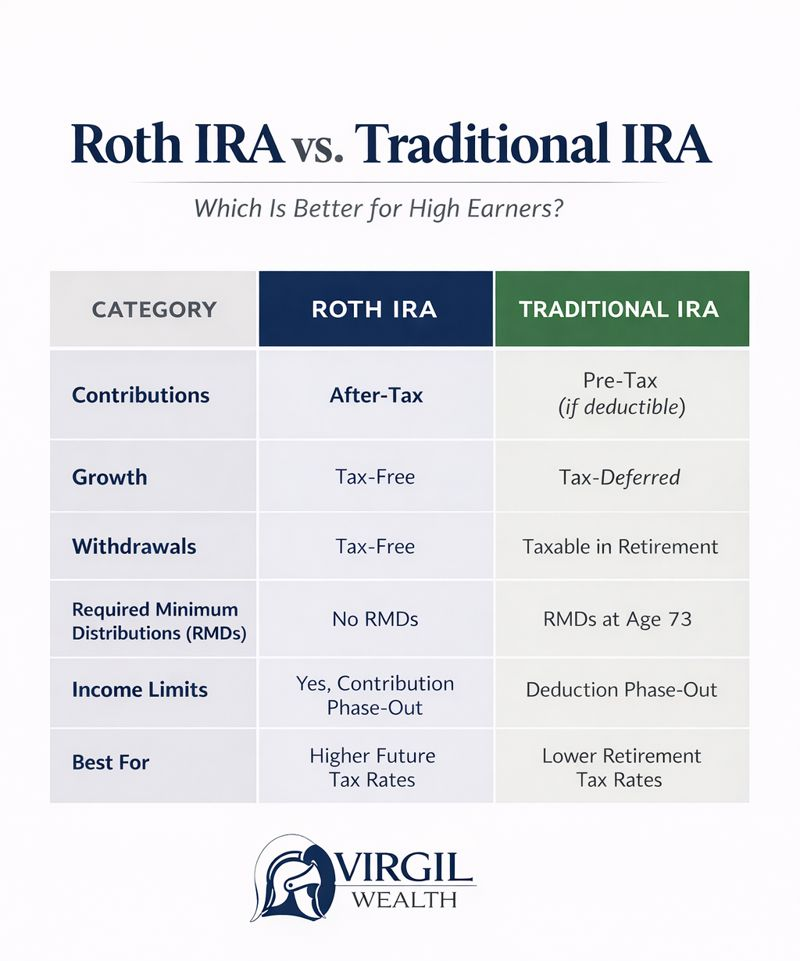
Which Is Better for High Earners?
When a Roth IRA May Be Better
A Roth IRA often makes sense if you:
Expect higher tax rates in the future
Want tax-free income in retirement
Are early or mid-career with income growth ahead
Want flexibility and no RMDs
Even if you can’t contribute directly, strategies like the Backdoor Roth IRA may still apply.
When a Traditional IRA May Be Better
A Traditional IRA may make sense if you:
Are in a peak earning year
Expect lower income in retirement
Can fully deduct contributions
Need immediate tax relief
However, many high earners cannot deduct Traditional IRA contributions, limiting the benefit.
What About Backdoor Roth IRAs for High Earners?
Because of income limits, many high earners use a Backdoor Roth IRA strategy:
Make a non-deductible Traditional IRA contribution
Convert it to a Roth IRA
When structured properly, this allows continued access to Roth benefits, but tax rules (like the pro-rata rule) must be managed carefully.
🔗 Related: Backdoor Roth IRA Explained
Common Mistakes High Earners Make
Assuming Roth IRAs are “off limits” forever
Ignoring the pro-rata rule
Failing to file Form 8606
Over-focusing on tax deductions instead of long-term flexibility
Not coordinating IRA decisions with employer plans
Final Thoughts
For high earners, the Roth vs. Traditional IRA decision is rarely black-and-white. The best choice depends on tax planning across your entire financial picture — not just this year’s return.
At Virgil Wealth, we help clients evaluate IRA strategies alongside investments, tax planning, and retirement goals to make informed decisions with confidence.
Want personalized advice? Schedule a free 15 minute consultation below!